Introducing the Interdisciplinary Leadership Lab
The Shelton Leadership Center is launching an innovative suite of offerings to support interdisciplinary leaders with a $50,000 grant.
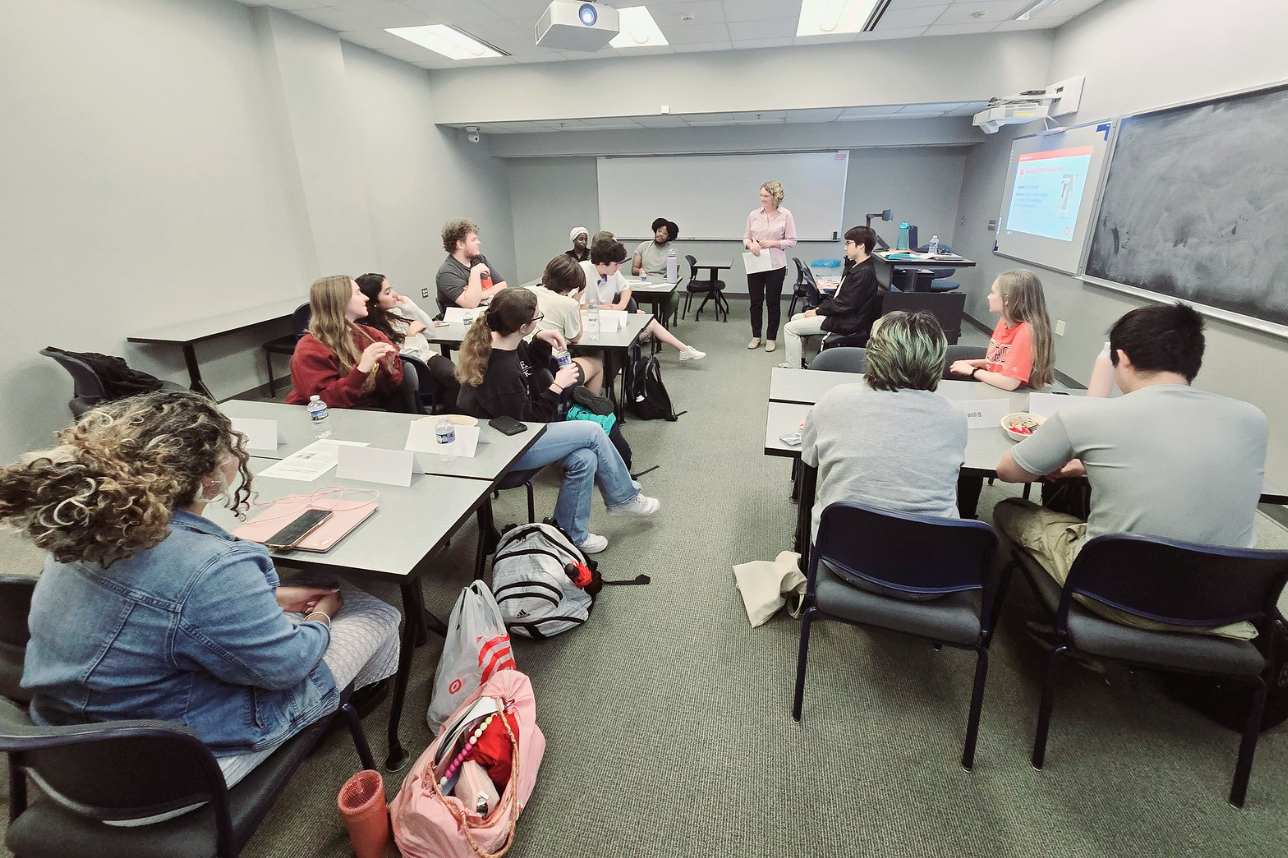
Following two successful pilot programs of the Thriving in Interdisciplinary Teams Workshop Series, the Shelton Leadership Center is proud to announce the launch of the Interdisciplinary Leadership Lab (ILL), made possible by a $50,000 grant from The NC State University Foundation, Inc.
The goal of the ILL is to increase student access to interdisciplinary education through the intentional and collaborative development of resources that can be used by faculty, staff, and leaders across campus. The grant from the NC State University Foundation will be used over the course of two years to support the roll out of the lab’s offerings.
“The Shelton Leadership Center is grateful to the NC State University Foundation for the support of our Interdisciplinary Leadership Lab through grant funding,” Dr. Debbie Acker, SLC Director, said. “This grant will allow us to offer new opportunities to the emerging values-based leaders across our campus and beyond, fostering meaningful conversations and connections centered on how to lead cross-functional teams successfully.”
Throughout fall 2025 and spring 2026, various offerings will be implemented as a part of the lab, including an expansion of the Thriving workshop series, interdisciplinary networking opportunities, a leadership video series, and a resource library. The features will be accessible to all at NC State and beyond. The expansion of the Thriving Workshop Series aims to enroll 350 students (a 700% increase) over two years.
“At the Shelton Leadership Center, we know that companies and organizations need leaders who can build and sustain cross-functional and interdisciplinary teams in order to innovatively solve complex challenges,” says Tiffany McLean, SLC Senior Associate Director, who will spearhead the launch of the lab. “Additionally, through our work with leaders at all levels, we see the need for leaders to develop skills to leverage the values, strengths, and experiences of every team member, not just their disciplinary expertise. This type of collaboration creates more creative and effective processes and outcomes. Students who participated in our Thriving in Interdisciplinary Teams Workshop Series expressed a need for expanded opportunities to explore leadership behaviors on cross-functional teams, and that is what the Interdisciplinary Leadership Lab aims to do.”

The Thriving in Interdisciplinary Teams Workshop Series launched in fall 2024 to address an educational gap in building teamwork strategies and cross-disciplinary communication. With a cohort of 15 students from 12 different majors, the series accomplished just that: collaboration and development across disciplines. Each month, students came together to work on their team building, problem solving, and ethical leadership skills through projects and discussions. When surveyed after the series, 100% of the students agreed that they could maximize the strengths of interdisciplinary team members to solve complex problems⸺a 31% increase since the start of the session.
The success of the Thriving Workshop series was just the beginning. The ILL will build on the momentum created by last year’s programs and will have the capacity to serve more students through innovative educational resources.
“I think this promotion of interdisciplinarity is key to fostering the confidence that students need to properly tackle real world problems,” said Kenzo Hubert, a fall 2024 workshop series participant and undergraduate student studying statistics in the College of Sciences.
Based on student feedback from fall 2024, spring 2025 students were offered four instead of three workshops. The program also included opportunities for reflection throughout the session, and the projects the students worked on spanned multiple meetings. A graduate student cohort was developed in the second pilot series to provide specialized experiences for their programs as well.
“As a grad student, this is a valuable experience because especially when you are doing a Ph.D, you are told that the main focus is just the technical knowledge,” says Anny Morales, a spring 2025 workshop series participant and graduate student studying forest biomaterials in the College of Natural Resources. ”But I think sometimes we tend to leave aside the leadership and other skills that are also valuable, especially when you are working with different people.”
“This workshop series allows students to engage across disciplines without the pressure of grades,” said Dr. Rhonda Sutton, Assistant Dean for Professional Development at the NC State Graduate School. “It creates space for experimentation, growth, and preparation for their future careers.”
Cross-functional collaboration is a valuable life skill with professional applications. Graduates with the capacity to bridge disciplines and tackle challenges in teams possess a career competency desired by over 81% of employers in the US, according to the National Association of Colleges and Employers.
Interdisciplinary education is even a part of NC State’s Wolfpack 2030: Powering the Extraordinary Strategic Plan, with Goal 1 being “empowering students to be entrepreneurial and independent thinkers, strong in their disciplines and experienced in interdisciplinary collaboration prepared to contribute impactfully in a global society.” The Interdisciplinary Learning Lab will meet this need by offering accessible and robust services for students of any degree program, college, and of course, discipline.
Yampiere Lugo-Acoste, the SLC Graduate Assistant for the Interdisciplinary Leadership Lab, will play a key role in daily operations of the program, and plans to facilitate training, coordinate with vendors, assist in building the resource library, and dedicate energy to the overall success of the ILL.


“The need for interdisciplinary educational resources on campus is growing, and we are seeing more students seek out this type of learning,” he says. “In my role as the Graduate Assistant for the Interdisciplinary Leadership Lab, I aim to provide students with the resources and training necessary to foster interdisciplinary collaboration in different communities and industries.”
The initial launch of the Thriving Workshop Series was made possible because of input from various partners within the NC State Office of University Interdisciplinary Programs (OUIP). According to Kristen Sullivan, Global One Health Academy (GOHA) Director of Undergraduate Programs and Assistant Teaching Professor in the NC State Department of Population Health and Pathobiology, who encouraged her Global One Health Scholars to participate in the 2024-25 Thriving Workshop series, the opportunity to further equip students with transferable teamwork skills is something that should continue to grow.
“The challenges we’re facing today are increasingly complicated and interconnected. No one discipline holds all the solutions,” says Sullivan. “This kind of training helps students develop the skills to work across disciplines and apply what they’ve learned to the issues they care about. I’d love to see programs like the Shelton Leadership Center’s reach even more undergraduate and graduate students.”
GOHA and the Integrative Sciences Initiative (ISI) will be partnering with the ILL to offer workshops and specialized lectures to their curriculum as well as plan to integrate our library of active learning resources into their interdisciplinary perspectives courses. Additionally, the Graduate School and other OUIP partners will be joining the ILL to offer networking events to interested students this year.
“These types of partnerships make it possible for interdisciplinary education to be available across all programs, which is why cross-training other leadership educators is such a priority of the ILL,” McLean said.
The Shelton Leadership Center welcomes all partners who would like to learn more and are interested in helping us build these resources that are relevant and easily accessible to everyone at NC State.


