
About Us
The Shelton Leadership Center has been developing values-based leaders across North Carolina and beyond since 2002.
Building the Next Generation of Values-Based Leaders
The Shelton Leadership Center was founded in 2002 by General H. Hugh Shelton following his retirement as Chairman of the Joint Chiefs of Staff. His desire to give back to his alma mater, North Carolina State University, prompted him to initiate a scholarship. Soon, his efforts grew to include educational programs, youth summer programs, and organizational development training focused on developing the next generation of values-based leaders.
The Shelton Leadership Center’s values-based leadership development programs now reach youth, college students, and professionals at NC State University and other higher education institutions, corporations, government entities, nonprofits, and youth development organizations.
We demonstrate our values-based approach by:
- Leading with accountability to our personal and professional ethics.
- Seeking unique perspectives and experiences to strengthen our impact and reach.
- Striving to understand and respect the thoughts, feelings, and needs of others to guide our actions.
- Collaborating with local and global communities to enact positive change.
Our Mission

Our Vision
The Shelton Leadership Center’s vision is to be a leading community of practice in values-based leadership development throughout pre-college, university, and professional communities, and eventually across the nation and world through access. Our Center will sustain and expand hands-on interdisciplinary training and skills development that emphasizes personal values, preparing future generational leaders for tomorrow’s greatest challenges.
ABOUT OUR FOUNDER
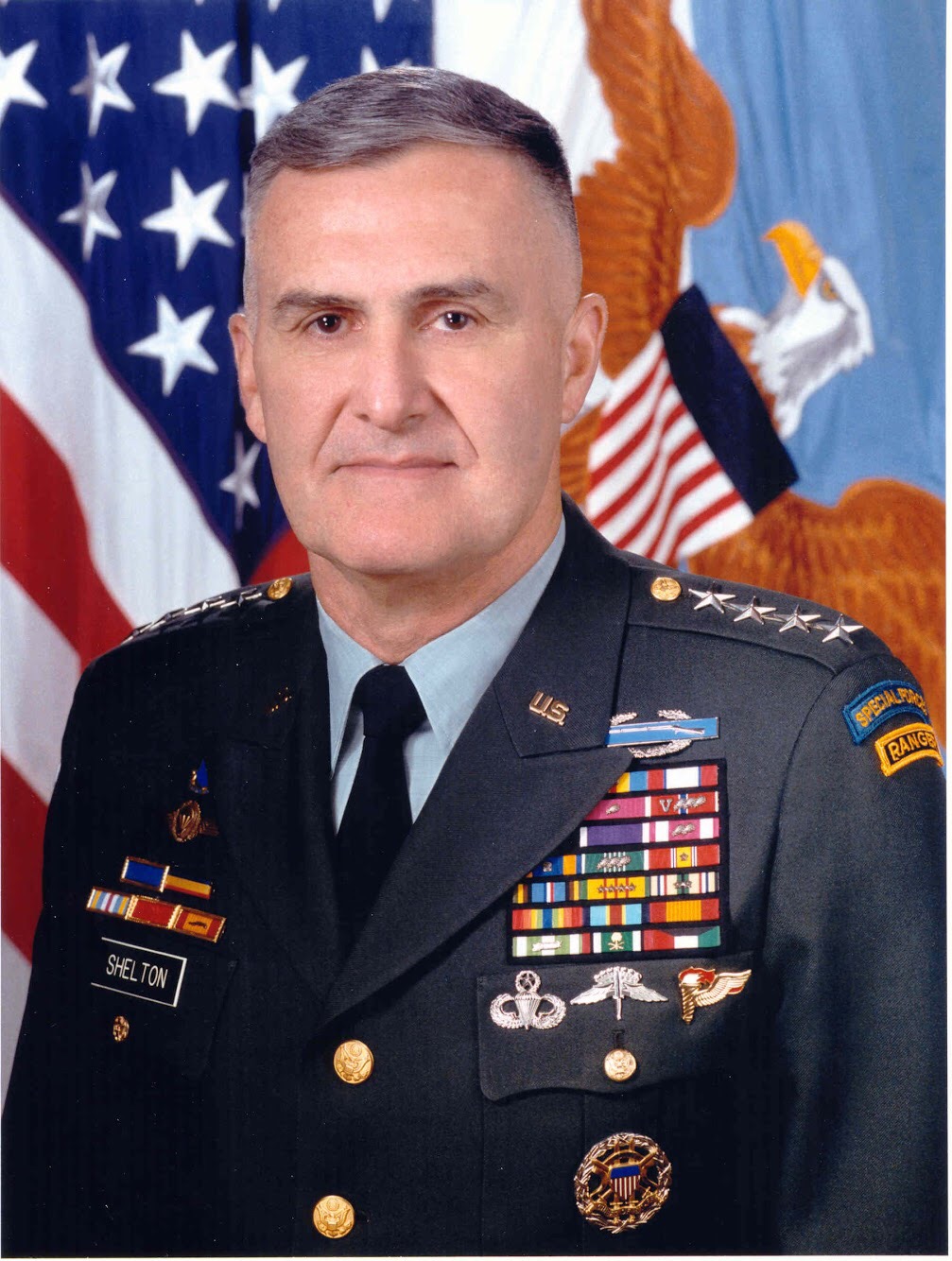
General Henry Hugh Shelton, USA (R)
14th Chairman, Joint Chiefs of Staff
Center Founder and Executive Director
Henry Hugh Shelton was born in Tarboro, North Carolina, and grew up on a farm near the small town of Speed. After graduating from North Edgecombe High School, he entered North Carolina State University. He enjoyed the Army Reserve Officer Training Corps (ROTC) and enrolled for an additional two years beyond the two then mandatory for men attending land-grant colleges.
2023-2027 Strategic Plan
In 2024 and 2025, the Shelton Leadership Center team dedicated time to refining our strategic plan through 2027. With an emphasis on expanding our Center’s reach and awareness, the strategic plan serves as a roadmap for achieving our long-terms goals.
Read more about our strategic goals and their aligned objectives:
Goal 1
The Center will build a multi-faceted integrated assessment, communication and marketing plan that builds on the legacy of General H. Hugh Shelton’s values-based leadership to inspire active engagement of university leaders, alumni, students, and other current and future key stakeholders with our mission and vision.
Objective 1.1: Communicate programmatic and operational impacts to current and prospective stakeholders to inspire their active engagement.
Objective 1.2: Celebrate, cultivate, and extend the legacy of General Shelton’s values-based leadership through our integrated communication and marketing plans.
Objective 1.3: Use data-informed storytelling to demonstrate the mission alignment of curricular and co-curricular leadership programs.
Goal 2
Goal 2
The Center will increase financial sustainability through diversified funding sources and mission-aligned partnerships that support innovative growth opportunities for existing and future initiatives.
Objective 2.1: Forecast and evaluate financial viability of existing programs prior to program and operation expansion.
Objective 2.2: Only enter into collaborative and synergistic philanthropic partnerships that are mission-aligned.
Objective 2.3: Create a stewardship strategy to support existing and future donors.
Objective 2.4: Develop and implement a funding model with diverse funding sources to support programs, sustaining Center operations, with consideration of access and affordability.
Goal 3
The Center will cultivate partnerships across NC State University to increase accessibility and impact of interdisciplinary values-based leadership development inside and outside the classroom.
Objective 3.1: Evaluate and prioritize strategic partnerships and programs that are interdisciplinary or interdepartmental in nature.
Objective 3.2: Increase pathways to SLC programming outside of the signature programs to engage a broader range of NC State stakeholders with consideration of access and affordability.
Goal 4
The Center will broaden its impact and reach by increasing values-based leadership development training and education across the state of NC.
Objective 4.1: Assess and explore opportunities to increase leadership development training through mission-aligned partners being mindful of access and affordability.
Objective 4.2: Generate awareness about the Center’s mission and services to external stakeholders.
Objective 4.3: Leverage University resources to broaden the scope of our outreach and extension efforts.
Goal 5
The Center will foster an organizational culture and community dedicated to best-practices in values-based leadership.
Objective 5.1: The Center will cultivate an organizational culture of care that supports all affiliated stakeholders through continuous improvement, reflection, and appreciation.
Objective 5.2: Identify, recognize, and celebrate students, alumni, and campus partners that are demonstrating community best-practices in values-based leadership.
Goal 6
The Center will serve as a nationally recognized thought leader dedicated to evidence-based leadership research and best practices across generations and disciplines.
Objective 6.1: Establish a research agenda to guide future research, assessment, and scholarship efforts that promote and support the Shelton Leadership Center’s mission and vision.
Objective 6.2: Position the Center as a nationally recognized thought leader by pursuing opportunities that boost credibility and expertise of our research efforts and best practices.
Objective 6.3: Generate thought leadership resources and publications that add valuable insight and perspective to the field of leadership.